13
Oct
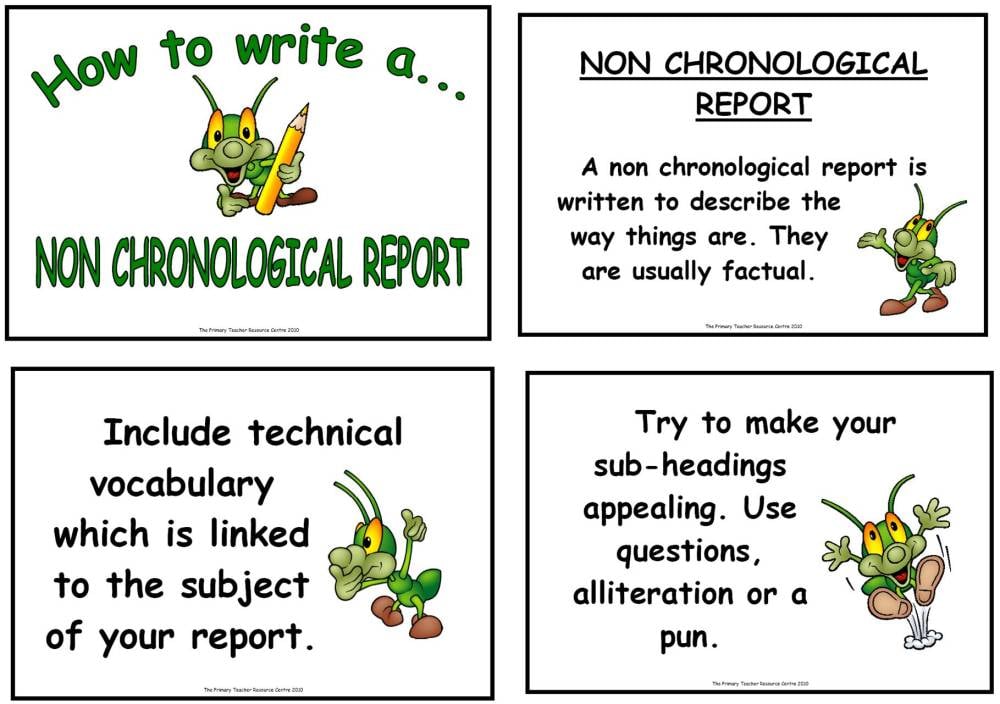
Its a great resource for children to use to keep track of their progress and make sure theyre understanding the main features of a non-chronological report. A non-chronological is not in time orderReport1s diagram is good because if someone could not read they could look at the picture and also there are 2 diagrams whereas Report2does not have a diagram.
Year 3 non chronological reports. NON-CHRONOLOGICAL REPORTS - YEAR 3 ENGLISH PLANNING Programme of Study objectives covered READING Word reading - Pupils should be taught to. Apply their growing knowledge of root words prefixes and suffixes etymology and morphology as listed in Appendix 1 both to read aloud and to understand the meaning of new words they meet read further exception words noting the unusual. A non-chronological is not in time orderReport1s diagram is good because if someone could not read they could look at the picture and also there are 2 diagrams whereas Report2does not have a diagram.
Report 1 is more interesting also it has a lot of information. Report 1 and 3 have captions for the diagrams whereas report 2 doesnt. Report 2 is the different of them all.
Report 3 has a. Explore more than 10000 Non Chronological Report Year 3 resources for teachers parents and pupils as well as related resources on Non Chronological Report. Non-chronological Reports - Year 3 English Planning - Autumn 1 Weeks 2 Aut006 to Aut010 Non-chronological Reports - Year 3 English Planning - Autumn 1 Weeks 2.
Displaying top 8 worksheets found for - Year 3 Non Chronological Report. Some of the worksheets for this concept are Report writing unit Year 6 geography the mountain environment Marshmallows lesson plans Honey bee report Year 3 school closure work to complete at home Volcanoes and earthquakes ks2 planning The beatles story learning resource pack Reading on the move. Writing non-chronological reports 7 days Teaching content.
Demonstrate how to write a non-chronological report see Grammar for Writing. Year 3 teaching units unit 9. Use the opportunity to demonstrate sentence structure and punctuation introducing connectives of reason and cause.
Children write their own non-chronological report. Contains a Powerpoint which looks at what a non-chronological report is as well as looking at the features of non-chronological reports. Also includes examples of reports that children can use and highlight to practice identfying these features.
BBC journalist Sonali Shah explains how writing non-chronological reports requires an understanding of the planning writing and drafting process. Our Features of a Non-Chronological Report Year 3 Checklist can be used by children to double-check either their own work or the work of their peers. Its a great resource for children to use to keep track of their progress and make sure theyre understanding the main features of a non-chronological report.
Weve included prompts for colour coding so that your learners can clearly identify. Lessons in this unit. To listen to an information text and answer questions.
To tell an information text from memory. To use descriptive phrases. To use the present tense.
To find key information in the text. Portia Spiders - Non-Chronological Report. Lessons in this unit.
To identify features of a non-chronological report. To revise compound sentences. To learn about the Portia Spider.
To develop a rich understanding of words associated with the jungle Part 1. Please watch the following video to recap the features of a non-chronological report. This video is slightly longer than the videos that will follow for the.
Our Features of a Non-Chronological Report Year 3 Checklist can be used by children to double-check either their own work or the work of their peers. Its a great resource for children to use to keep track of their progress and make sure theyre understanding the main features of a non-chronological report. Weve included prompts for colour coding so that your learners can clearly identify.
A super wagoll for a non-chron unit. Lots of pages with well worded sentences and fantastic layouts for an AF4 layout guided read. Said to originate from the library of eminent Victorian dragonologist Ernest Drake this book imparts to readers the secrets of the ancient science of dragonology.
It includes a host of novelties such as old letters magic dust dragon scales gems.
Previous post
Yellow wallpaper lesson planNext post
Yankee doodle dandy lyrics meaning